Subscribe Now!
...with web-based news readers. Click your choice below:




...with other readers:

FeedBurner makes it easy to receive content updates in My Yahoo!, Newsgator, Bloglines, and other news readers.
Learn more about syndication and FeedBurner...
Current Feed Content
-
Review: Star Trek: Voyager: Full Circle
Posted: Wed, 02 Feb 2011 20:30:59 +0000


Buy It Now: on Amazon
Description: When the U.S.S. Voyager is dispatched on an urgent mission to the planet Kerovi, Captain Chakotay and his first officer, Commander Thomas Paris, must choose between following their orders and saving the lives of two of those dearest to them. B’Elanna Torres and her daughter, Miral, are both missing in the wake of a brutal attack on the Klingon world of Boreth. With the aid of their former captain, Admiral Kathryn Janeway — as well as many old friends and new allies — Voyager’s crew must unravel an ancient mystery, placing themselves between two warrior sects battling for the soul of the Klingon people…while the life of Miral hangs in the balance.
But these events and their repercussions are merely the prelude to even darker days to come. As Voyager is drawn into a desperate struggle to prevent the annihilation of the Federation, lives are shattered, and the bonds that were forged in the Delta Quadrant are challenged in ways that none could have imagined. For though destiny has dealt them crushing blows, Voyager’s crew must rise to face their future…and begin a perilous journey in which the wheel of fate comes full circle.
This review is based on a copy I bought myself.
Marron’s Review:
Voyager has had a rocky few years as far as novels go. The very first novel to take place after Voyager’s return from the Delta Quadrant, Homecoming, was written like bad fanfiction. The three books that came after that were less than spectacular, only slightly better than Homecoming — but just barely. The Star Trek novelists and publishers seemed to get the hint and shelved Voyager novels, thankfully giving us a reprieve from the tepid writing that had plagued the relaunch of the series from television into novel format.Of course, as the Trek world moved on, the Voyager crew slowly crept back into view, namely Kathryn Janeway and Seven of Nine. As the events leading up to David Mack’s epic Destiny trilogy unfolded, we as readers and fans were left with questions and loose ends from previous Voyager novels. What was desperately needed was a novel that dealt with the tragedy the Voyager crew faced in the novel Before Dishonor; what was needed was a novel that tied up the loose ends that were created in Homecoming. Kirsten Beyer’s novel Full Circle does both of these things, and more.
A book that goes back and forth between the “present” of the Trek universe and the past–to different points right after Voyager made its return three years ago in cannon time — Full Circle wraps things up quite nicely. At a stunning 560 pages, Full Circle explores every major character from Voyager in depth — with the exceptions of Admiral Janeway (who is still mentioned) and Tuvok (who is now a part of the Titan crew, but makes a cameo appearance). Full Circle shows how the crew of Voyager drifts apart, and how they find themselves back together again, even if the circumstances are less than ideal. There are new faces and old faces, and — as the title suggests — the crew finds themselves coming full circle as they embark on a new mission as the novel closes.
This book is not light-hearted. It is a painful journey for all of those involved as they struggle with their lives and coming to terms with where those lives have taken them — and with the death of one of their most beloved friends. The ending is bittersweet but the epilogue leaves us with a bit of wondering hope — and curiosity.
Overall, this was an excellent book. Voyager was not my favorite series, but I did enjoy it, and this novel finally did justice to the good parts of the series. It is important to have read the TNG novel Before Dishonor before reading Full Circle, and helpful to read David Mack’s Destiny trilogy as well. Otherwise, you may be in for a few big and unsettling surprises. The novel is good, but a little hard to follow at certain points because it skips around in time (not to mention that this could have, likely, been split into two books), but the story is good enough that this is forgivable. I’ve done my best to stay away from Voyager novels after Homecoming, but Full Circle has brought me back, so to speak, to remind me of the things that I loved about Voyager; and that alone definitely makes it worth the read.

Reviews Elsewhere
TrekWeb
Total Sci-Fi
The Tancave
HellHorror.com
 Marron Marvel
, sometimes known as Tiarra, is a comic book and sci-fi geek girl who enjoys reading, playing video games, listening to The Beatles, and comparing everything to “that one episode of TNG where…” Although she claims to be a Lt. Commander in Starfleet and the Chief Engineer of the U.S.S. Cyberdyne, she is actually a professional graphic designer, and a published journalistic writer, living in Las Vegas, where she enjoys avoiding casinos and spoiling her fat, orange cat that may or may not hate Mondays. She can be contacted at tiarra @ geek-life.com.
profile | twitter Share TDF:


Related posts:
- Review: Star Trek: Destiny Trilogy
- Review: Star Trek: Troublesome Minds
- Review: Star Trek: Myriad Universes: Echoes and Refractions
-
Blog Game Time!
Posted: Tue, 01 Feb 2011 22:58:56 +0000
 I yoinked this from someone on LiveJournal, but it sounds like so much fun that I’m posting it here.
The Game:
1) Make a list of fifteen characters first, and keep it to yourself for the moment.
2) Ask your readers to post questions in the comments. For example: ‘One, nine and fifteen are chosen by a prophecy to save the world from four. Do they succeed?’ ‘Under what circumstances might five and fourteen fall in love?’ ‘Which character on the list would you most want on your side in a zombie invasion?’ ‘Write a drabble in which three and eleven fight crime.’ (…possibly not technically a question.)
3) After your readers has asked enough questions, round them up and answer them using the fifteen characters you selected beforehand, then post them.
I’ve got my fifteen characters. Now it’s up to you, dear readers. Post your questions!
 TDF Pamela
The Discriminating Fangirl, who is more likely to answer to Pamela if you shout it at her, is the proud owner of an MA in English, focusing on children's/young adult literature and popular culture. Because of her ample free time thanks to being gainfully unemployed, she reads voraciously. She also loves geeky movies and tv shows, reads comic books as often as she can buy them, and when she's procrastinating, she enjoys playing video games. She can be contacted at t.d.fangirl @ gmail.com and followed on Twitter at the link below.
profile | twitter Share TDF:
No related posts.
-
Film Review – Four Lions
Posted: Tue, 01 Feb 2011 22:12:42 +0000
 Four Lions Written and Directed by Chris Morris
Description: A handful of young men set out to take on the decadent West but are more of a threat to themselves than anyone else. Omar (Riz Ahmed) has decided to form a terrorist cell to bring forth a jihad against a culture he believes is dominated by the sinful and ignorant, however Omar isn’t much of leader and he’s assembled an unimpressive team of fellow terrorists. Waj (Kayvan Novak) lacks the brainpower to come up with ideas or direction on his own, Faisal (Adeel Akhtar) is shy and doesn’t have much to say and Barry (Nigel Lindsay) is a recent convert to Islam who tries to make up for his lack of practical knowledge with fierce passion. But are Omar and his partners a legitimate threat to the safety of Great Britain, or just four half-bright twenty-somethings with more bluster than imagination?
This review is based on a copy I bought myself.
Lady-T’s Review: On the surface of it, Four Lions is one of those films where you look at the synopsis and wonder how anyone ever thought it was going to be a good idea. Because let’s be honest, when talking about what is a sensitive and contentious topic like terrorism, suicide bombing and Islamic fundamentalism, most filmmakers aren’t going to want to touch it with a ten foot pole, let alone make it into a dark comic farce.
But then again, most filmmakers aren’t Chris Morris.
For those who have never seen his caustic and unflinchingly cynical mid-90′s series The Day Today or its successor, Brasseye, it’s worth pointing out that Morris does have a bit of a reputation in the UK. His notorious Brasseye Paedophile Special received a record number of complaints when it first aired on Channel 4, and with contemporaries and regular collaborators such as Armando Iannucci (The Thick Of It, In The Loop) and Charlie Brooker, it’s not awfully hard to guess the tone that Morris’ work tends to take.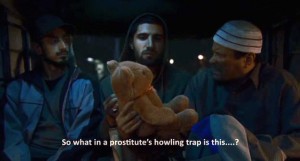
It's my prayer bear. It does my prayers...
Four Lions is his debut feature film, but his stylistic fingerprints are much in evidence beneath the rapid-fire dialogue and the understated absurdity of the humour. The story focuses on a small group of British Islamic terrorists and their attempts to organise a synchronised, meaningful attack within the UK. They are hampered by a generally disinterested society and a complete lack of common sense, grounded firmly within the realms of a quite apathetic suburban existance. These are guys with lives and jobs and middle-class aspirations seeking an excuse for personal glorification rather than the furthering of any real idealistic standpoint. What thwarts them is not any particular fault with their religion or conviction, but instead their own intense and crippling individual stupidity.
It is this particular choice that probably saves the film from falling into the most overtly offensive pitfalls. The characters are not defined by their religious affiliation, they are instead just astonishing morons. Ejected from a terrorist training camp in Pakistan for gross incompetence, and trying to hold secret planning meetings across children’s IM service ‘Party Puffins’, it is always clear that it is the characters as individuals who are to blame for their actions and, rather than vilifying their faith, it’s their very human half-assed vanity that is ultimately the point of ridicule.
That said, no side fares particularly well from Morris’ observational standpoint. The authorities emerge from it just as useless as the terrorists themselves, and there’s a fabulous exchange between two Police marksmen on a rooftop about The Honey Monster, a wookiee, whether either of them is actually a bear and which one of them they’re supposed to shoot at, that rather sums up the tone of the film as a whole.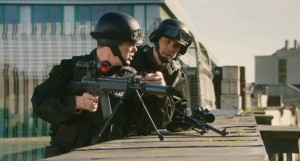
That's not a Honey Monster, that was a Wookiee
It is by turns graphic, insane and surprisingly humanising. There are parts that should, rationally speaking, be more horrific than hilarious but yet it is hard not to laugh. Because some of the things that happen are so absurd and unexpected, even though part of your brain is aware that it’s wrong you sort of can’t help but find it funny.
Four Lions is admittedly not for the sensitive. There is animal death, human death, offensive language and a sense of humour that’s more inclined to sneak up on you with facepalm-inducing disbelief than outright belly-laughs. Additionally the hand-held camera style can be a little wearing at times. But it makes for what can only be classified as a genuinely unique and original viewing experience. If you can get past the occasionally obscure British vernacular there’s a rewarding level of naturalism to the script and performances, and a taste of genuine pathos at its ultimate conclusion.
I’ve seen Four Lions a number of times now and I find that I like it more with each subsequent viewing. I am continually finding new points and incidental asides worthy of note in what is already a densely packed, dialogue-heavy script. It’s probably not the kind of film you watch for light entertainment, it is quite dark and unflinching and may require a little work if British slang is not among your native languages, but ultimately it is also very much worth the effort.

Reviews Elsewhere
The Telegraph
The Guardian
Time
Time Out London
Empire
 Lady T
 is a great lover of British TV, which is helpful as that's mostly what she gets to watch. She strongly believes that tea can't be made using a microwave, that children's programming really was better when she was a kid, and that there's nothing in the world that can't be solved with a liberal application of common sense. She very much enjoys reading but like most of the rest of the world would some day like to write a book herself. If she ever succeeds in doing so there's a pretty good chance she'll never shut up about it. She can be contacted at lady_t_220 @ yahoo.co.uk.
profile Share TDF:
Related posts:
-
How Should We Define Geek Culture?
Posted: Tue, 01 Feb 2011 19:42:53 +0000
In PCMag, Will Greenwald explains that “geek culture isn’t dead. It’s just hidden” behind a huge wall that separates what’s considered geeky from the rest of pop culture. Greenwald makes some very interesting points, many of which I’d agree with, but I see a major problem with his article.
Do geeks really need to draw a line in the sand? And how do we as geek culture in general establish what’s geeky and what’s not?
On one hand, I’m all for the democratization of geek. As a geek girl, I’ve had to deal with people not accepting me as a geek just because I’m female. On top of that, there are some borderline-geek fandoms that I (along with many other geek girls) have a geek-obsessive level of love for. Urban fantasy in particular has punched through Greenwald’s wall, bringing vampires and werewolves into mainstream pop culture. Does that mean that I’m less geeky because I love the Sookie Stackhouse books and True Blood? Nah, I geek out over vampire books (well-written ones) just as much as I geek out over Farscape. And I certainly wouldn’t want to discourage a teen girl who loves vampires from using those fandoms as a gateway to other forms of science fiction and fantasy.
On the other hand, I definitely can see that wider pop culture has co-opted the term “geek” in ways that diminish what it means for those of us who’ve been geeky far longer than comic book movies have been mainstream popular. Black glasses and ironic, nerdy t-shirts do not a geek make, and it is irritating to see that kind of thing trumpeted as being geek by popular media. Yes, I wear black glasses and have tons of nerdy shirts, but I also watch and read science fiction and have an office full of superhero toys. Does that hipster have a Phoenix toy sitting on his monitor? Probably not, and knowing that makes me feel more geeky.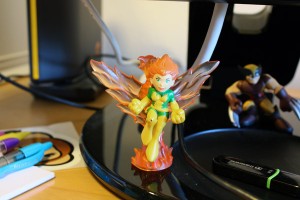
My geeky monitor base.
I’m kind of territorial about my geekiness, but at the same time, I want to be open to other geeks’ interpretation of what geek means. Reading the comments on Greenwald’s article made me feel like I was reading an attempt to define geek in order to exclude others, like making rules so other kids can play in your playhouse. To be a geek, do you absolutely have to be a tabletop RPG gamer? Or quote obscure SF movies? Or be able to build your own computer from scratch?
I do want geek culture to continue to thrive, and I do think that despite popular media’s current love affair with geek, we’re still on the other side of a wall from the mainstream. I’m okay with that. But I also worry that attempts to define what constitutes “geek” will only fragment geek culture. Maybe that’s inevitable, though I hope not. I’m enjoying the surge in popularity in geeky fandoms, and I’ll probably still enjoy those fandoms after the mainstream moves on to something else.
What’s your take? Do you think that geek culture should be open and all-encompassing, allowing anyone who defines as geek to be a part? Or do you think it should tighten its borders, so to speak, and fight against the mainstreaming? Or are you like me, someone who falls somewhere in between those two options?

TDF Pamela
The Discriminating Fangirl, who is more likely to answer to Pamela if you shout it at her, is the proud owner of an MA in English, focusing on children's/young adult literature and popular culture. Because of her ample free time thanks to being gainfully unemployed, she reads voraciously. She also loves geeky movies and tv shows, reads comic books as often as she can buy them, and when she's procrastinating, she enjoys playing video games. She can be contacted at t.d.fangirl @ gmail.com and followed on Twitter at the link below.
profile | twitter Share TDF:
Related posts:
-
Instant Review: Being Human (US) – “Some Thing To Watch Over Me”
Posted: Tue, 01 Feb 2011 04:34:59 +0000
 It’s episode three of Syfy’s Being Human and you know what? It’s coming into its own earlier than I expected. This week roughly corresponds to the Gilbert episode of the BBC original. Fans of the UK Being Human will know what I mean without spoiling it for those new to the series.
What follows contains some minor spoilers for this weeks Being Human (US) episode.
This was a more Sally-centric episode, possibly moved up from the original running order because we haven’t gotten to see much of Sally before this. The guys introduce her to Tony, the ghost of a mulleted headbanger who died in 1987. He teaches Sally how to move around the house instantly and, as her confidence develops, into the outside world. We also see Tony’s Door, because Sally has made such an impression on him that Tony can now move on. It will be interesting to see if the afterlife in the US series will be the same as the UK series which, with the exception of Gilbert’s (the ghost the Tony character was adapted from) Door, seems altogether darker than we’ve seen so far from Syfy.
Knowing she can now leave the house, Sally mentions to Josh that she thinks she’ll move to Danny’s place. Surprisingly, Josh admits he doesn’t want her to leave. This is a major step in their relationship because, up to now, Josh was still kind of wishing Sally would just move on. And speaking of changes for Josh, he finds it hard to control his more violent urges while on his new neighborhood watch rounds. He can’t stop himself from attacking a graffiti artist while his watch buddy looks on in shock. Josh later admits that it’s getting harder to separate the two sides of himself when other people’s safety is at risk. It’s interesting that Josh recognizes the wolf as part of himself – that’s something it took George (the UK werewolf for those coming in new to BH) longer to really internalize.
Maybe Sally won't be so glum now that she can leave the house
Aidan has a trickier problem. One of Bishop’s officers on the BPD seems to remember someone who looked an awful lot like Aidan who killed his father when he was ten. Officer Michael Garrity continues to press the issue to the point of violence, forcing Bishop and crew to take matters into their hands. Aidan opts for the Jedi mind trick, but the results are not at all what he expected.
Now that we’re starting to get more character development and the housemates are becoming more distinct from their British counterparts, I’m liking the series more. Sure, there’s still some deja vu, but the characters are starting to come into their own. They’re not there yet, but they’re getting there. I love how thrilled Sally was to be able to touch Tony, felt a little of Josh’s horror at losing control and I am really loving the different dynamic between Aidan and Bishop that seems more sinister, with so much more animosity than the relationship between Mitchell and Herrick in the BBC series. How will that play out? Only time will tell.
 WereGeek
 is reading 5-7 books at any given time, none of them very fast. These can range from alternative universe fiction to historical non-fiction and from theoretical physics to Uncle John’s Bathroom Reader. You can argue with her all you want, but Dirk Benedict will always be her Starbuck. Her ringtone is the theme from Airwolf and she believes that there's nothing that can't be improved by the judicious application of werewolves. Or bacon. Or werewolves with bacon. She can be contacted at werewolf17 @ gmail.com and followed on Twitter at the link below.
profile | twitter Share TDF:
Related posts:
- Instant Review: Being Human (US)
- Instant Review: Being Human (US) – “There Goes the Neighborhood, part 2″
- Lost Epilogue… watch fast!
-
Review: The Iron Queen by Julie Kagawa (The Iron Fey Book 3)
Posted: Mon, 31 Jan 2011 22:14:49 +0000
 The Iron Queen by Julie Kagawa
Buy It Now: from eHarlequin: Trade Paperback
from Amazon: Trade Paperbackor Kindle edition
from Barnes & Noble: Trade Paperback or NOOKbookDescription: My name is Meghan Chase.
I thought it was over. That my time with the fey, the impossible choices I had to make, the sacrifices of those I loved, was behind me. But a storm is approaching, an army of Iron fey that will drag me back, kicking and screaming. Drag me away from the banished prince who’s sworn to stand by my side. Drag me into the core of conflict so powerful, I’m not sure anyone can survive it.
This time, there will be no turning back.
This review is based on a copy received from the publisher
TDF Pamela’s Review:
I was a little worried that I wouldn’t enjoy The Iron Queen since I got a bit curmudgeonly about The Iron Daughter and its love story. Luckily for me, Ash the Ice Prince is nicely fleshed out in the third book in Julie Kagawa’s Iron Fey series, which seriously helps me buy into the love story, and Meghan Chase not only grows into her heavily foreshadowed role but also becomes a braver, stronger young woman. Hooray!
Beware spoilers for The Iron King and The Iron Daughter in this review!
When we last saw Meghan and Ash, they had been exiled from Faery for their star-crossed love. The Iron Queen picks up with the couple in the mortal world. Alas, they can’t expect to have a white picket fence and a normal life, though, because the false Iron King is moving on the Seelie and Unseelie courts, and the pair quickly find themselves squarely back in the middle of the problems faced by the courts that shunned them.
The Iron Queen picks up the pace that dropped off in The Iron Daughter. The beginning is a bit slow because Meghan is trying to learn how to control her magic. She’s half-Seelie, which gives her Summer glamour, but her run in with Machina, the former Iron King, has also gifted her with Iron glamour, and unfortunately for her, the two don’t seem to mix very well. When she’s called upon to get rid of the new Iron King, she has to do so with her wits only, since trying to use either type of glamour makes her very ill.
I was definitely pleased by Meghan’s growth as a character. At the beginning of the book, she does spend an alarming amount of time burying her face in Ash’s shirt, but over the course of the story, she learns to fight and defend herself and also comes to terms with her responsibilities. By the end of the book (no spoilers!) it’s obvious that even her ideas on love and relationships have matured (thank goodness), and she faces her new burdens with her head held high, even if her heart is breaking. Now, I admit that I don’t read teen lit all that often, but much of what I’ve read involves a heroine who doesn’t seem to grow much over the course of the series (I’m looking at you, Twilight). She starts off the series as a whiny teenager and ends in pretty much the same place. It was refreshing to see Meghan move beyond that. Even though she’s still young, she realizes what an enormous responsibility is ahead of her, and instead of whining and refusing to deal with it all, she does what’s necessary and moves on. I know that’s incredibly vague, but I don’t want to spoil the ending of the book for you, so bear with me.
The Iron Queen is exciting and nicely romantic with a heroine who is smart and who grows up in a believable way.
Reviews Elsewhere
Literature Young Adult Fiction
Cry Havoc Reviews
Books With Bite
Vampire Book Club
TDF Pamela
The Discriminating Fangirl, who is more likely to answer to Pamela if you shout it at her, is the proud owner of an MA in English, focusing on children's/young adult literature and popular culture. Because of her ample free time thanks to being gainfully unemployed, she reads voraciously. She also loves geeky movies and tv shows, reads comic books as often as she can buy them, and when she's procrastinating, she enjoys playing video games. She can be contacted at t.d.fangirl @ gmail.com and followed on Twitter at the link below.
profile | twitter Share TDF:
Related posts:
- Review: The Iron Daughter by Julie Kagawa (The Iron Fey Book 2)
- Review: The Iron King by Julie Kagawa (The Iron Fey Book 1)
- The Iron Queen Giveaway!
-
The Iron Queen Giveaway!
Posted: Mon, 31 Jan 2011 17:00:56 +0000
To celebrate the release of The Iron Queen, the third book in Julie Kagawa’s series, The Discriminating Fangirl is pleased to present…
The Iron Queen Giveaway!
About the Iron Fey Series:
In The Iron King, debut author Julie Kagawa introduced a new, evolved order of faery. In less than twenty-four hours Meghan Chase will be sixteen. Countless stories, songs and poems have been written about this wonderful age, when a girl finds true love and the stars shine for her and the handsome prince carries her off into the sunset. But Meghan suspects that it won’t be that way for her. After all, Meghan has a secret destiny—one she could never have imagine.
In The Iron Daughter, Kagawa explores love and betrayal in a faery world gone mad. A half faery princess, half human girl becomes a pivotal part of a deadly conflict between two warring factions of faery.
The winds of war gather in Kagawa’s newest novel, The Iron Queen. Meghan Chase thought they’d left Faery behind forever, but pressing matters cause the three exiles to be summoned to war. A new alliance is made, along with a few contracts, of course, and Meghan, half Summer faery princess, half human, is pressed to choose Fey over her mortal beginnings. Will she abandon her human heart for an iron will that will help her survive? For as Meghan can confirm—in real life, unlike books, faery tales don’t necessarily have happy endings.
Become a fan of The Iron Fey on Facebook!
The Iron Queen Book Trailer:
The Details
TDF is giving away one (1) set of The Iron Fey books:
- The Iron King
- The Iron Daughter
- The Iron Queen
The contest is open only to entrants with a U.S. or Canadian mailing address, and is sponsored by Harlequin Teen. The giveaway starts today (Monday, January 31) and will run for two weeks. The last day to enter is Monday, February 14. The winner will be chosen randomly and contacted by email on Tuesday, February 15, and will have four days to respond. If the winner does not respond by Saturday, February 19, a new winner will be chosen.

How to Enter:
TDF Pamela
The Discriminating Fangirl, who is more likely to answer to Pamela if you shout it at her, is the proud owner of an MA in English, focusing on children's/young adult literature and popular culture. Because of her ample free time thanks to being gainfully unemployed, she reads voraciously. She also loves geeky movies and tv shows, reads comic books as often as she can buy them, and when she's procrastinating, she enjoys playing video games. She can be contacted at t.d.fangirl @ gmail.com and followed on Twitter at the link below.
profile | twitter Share TDF:
Related posts:
- Review: The Iron King by Julie Kagawa (The Iron Fey Book 1)
- Review: The Iron Daughter by Julie Kagawa (The Iron Fey Book 2)
- Giveaway: Naamah’s Curse by Jacqueline Carey
-
Supernatural Saturdays – Impromptu Man Candy Edition
Posted: Sat, 29 Jan 2011 21:48:31 +0000
Hellatus was supposed to be over last night. However, in the CW’s infinite wisdom, they pulled the episode and aired a rerun of Nikita. Their reasoning was that American Idol was on, well I think I can speak for most of my fellow fans and say that if we’re given the choice between American Idol and Supernatural, we’re watching Supernatural. Anyway, mini rant over, now for the pretty.

I found this via Tumblr and love it. Powers!Sam is seriously one of the hottest things on the show. Almost as hot as this:
I’ll give you all a minute.
Good? Good because here’s one of my favorite pictures of Dean. It is just absolutely gorgeous.

We finally were given new promo pictures for this season. This one… unf.

Don’t think I’m leaving out Cas! As stupidly pretty as my boys are, I do love the guy.

One of my favorite developments in his character is seeing him become more human (or completely human in “The End”). Angel!Cas is fun, but seeing that change was so much more interesting and, at times, hilarious (“I found a liquor store and drank it.”)

Image Credit: Tumblr, TV Chitchat & Daemon’s TV.
 Amanda
 has loved to read since she was 3 and was a fangirl from the start. She has a B.A. in French and studied in France. This fall she will start her MLIS program at Kent State. She hopes to work as an academic or reference librarian. She can be contacted at tarteamandine @ gmail.com and followed on Twitter at the link below.
profile | twitter Share TDF:
Related posts:
- Man Candy: Supernatural
- Supernatural Saturdays – Supernatural Gift Guide
- Supernatural Saturdays – “The Third Man” s06e03
-
Review: Star Trek: Destiny Trilogy
Posted: Sat, 29 Jan 2011 19:00:17 +0000
 Star Trek: Destiny by David Mack
Buy It Now: Amazon:
Book I: Gods of Night
Book II: Mere Mortals
Book III: Lost SoulsDescription: Half a decade after the Dominion War and more than a year after the rise and fall of Praetor Shinzon, the galaxy’s greatest scourge returns to wreak havoc upon the Federation – and this time its goal is nothing less than total annihilation.
Elsewhere, deep in the Gamma Quadrant, an ancient mystery is solved. One of Earth’s first generation of starships, lost for centuries, has been found dead and empty on a desolate planet. But its discovery so far from home has raised disturbing questions, and the answers hearken back to a struggle for survival that once tested a captain and her crew to the limits of their humanity.
From that terrifying flashpoint begins an apocalyptic odyssey that will reach across time and space to reveal the past, define the future, and show three captains – Jean-Luc Picard of the U.S.S. Enterprise, William Riker of the U.S.S. Titan, and Ezri Dax of the U.S.S Aventine – that some destinies are inescapable.
This review is based on copies I bought myself.
Marron’s Review:
Star Trek: Destiny is a three-part crossover series that brings four captains together to save not only the Federation, but perhaps the universe itself. Captains Jean-Luc Picard, William Riker, Ezri Dax, and Erika Hernandez must join forces to bring down one of the Federation’s most hated and feared enemies: the Borg.
My initial reaction was, “The Borg? Again?” because the TNG relaunch novels preceding Destiny have involved the Borg as well. I assure you, however, that as wary as I was about reading yet another Borg book — let alone a trilogy — I was not disappointed in the least.
The Borg have been continually adapting and evolving as time has progressed, and this is evidenced in the novels I’ve read preceding the Destiny trilogy. At the end of the previous TNG relaunch novel, Greater Than the Sum by Christopher L Bennet, the Borg left the Federation with a dark message: two planets destroyed, billions of people dead, and the words, “We are the Borg. You will be annihilated. Your biological and technological distinctiveness have become irrelevant. Resistance is futile but welcome.”
Reading those words sent shivers down my spine; it definitely wasn’t the end of things with the Borg, but a gruesome beginning. Imagine a fleet of over 7,000 Borg Cubes spreading out and invading Federation space — and that of every nearby ally or enemy, the Klingons, the Romulans, the Cardassians, the Breen, and on and on. This is just one small part of what David Mack has to offer for the Destiny trilogy.
The story is intriguing, although it was a bit confusing at the beginning. The story skips back and forth in time, from “present day,” where Picard and the others reside, to the “past” where Erika Hernandez — Captain of the NX-02 Columbia and former love of Captain Jonathan Archer — and her crippled ship and injured crew use a special subspace flight technique to travel to a planet 12 light-years away in what feels to them to be a matter of months instead of years.
At first, I wasn’t certain what Hernandez and the crew of the Columbia — or the Caeliar, the aliens that Columbia encountered at the end of its 12 years of travel — had to do with the story. It was, nonetheless, intriguing. I had postulated a hypothesis that turned out to be completely wrong (though a good guess!), and I didn’t actually guess the “surprise twist” to the entire story until the third book.
All three books in the Destiny trilogy kept me wanting more. It was 2 o’clock in the morning when I finished the first book, Gods of Night, and I couldn’t help myself as I scurried around my room looking for the second book, Mere Mortals, so I could continue reading the story. David Mack had completely pulled me in; granted, it took about a third of the first book before I did get pulled in, but once it happened, there was no stopping it. I was hooked.
I don’t want to go into too many details, because I don’t want to ruin the story. I think knowing that the Borg are trying to destroy the Federation after years of the Federation meddling with their affairs pretty much sums up all you need to know before reading these books. The knowledge that billions of lives could be lost, that foes and allies alike must come together for what seems to be a futile battle and find a way to win against such an unstoppable force should suffice. To say any more would be to ruin the stories and the books, and I simply refuse to do that because these books were so good.
The writing is excellent. The characterization for all of the major characters was, I felt, spot on. I don’t think I’ve seen anyone — not even Peter David — tackle Picard and his feelings for/relationship with the Borg as deeply and gut-wrenchingly as David Mack has in these books. The emotions of all of these men and women are beautifully displayed in a way that makes it easy for the reader to understand and even relate; there were times during these books that I found myself moved to tears — actually crying over the things that some of my favorite characters were going through, the pain that they were feeling. I can honestly say that this is a sign of excellent writing because I read a lot of books, and despite sadness and hardships in many of them, I have only actually cried while reading two other books prior to this series.
The story, too, is a masterpiece. I will admit that it felt as though it dragged out in a few places — but those places were few and far between. There is plenty of action with just enough description to get you picturing the story in your head, hearing the voices of those familiar to Trek fans throughout the years — but the writing style isn’t too heavy or burdening; sometimes storytellers will go too far into description or linger too long, use prose that doesn’t fit — David Mack does none of that. The writing is good.
At this point, I feel to say anything else would just be rambling or repeating. This is a fantastic series that will appeal to Trek fans of many different Star Trek series and brings together a wide variety of characters in a compelling and thoughtful way.

Reviews Elsewhere
Trek United
Slice of SciFi
Chris Jones Gaming
SciFi Chick
TV Loop
Marron Marvel
Marron Marvel, sometimes known as Tiarra, is a comic book and sci-fi geek girl who enjoys reading, playing video games, listening to The Beatles, and comparing everything to “that one episode of TNG where…” Although she claims to be a Lt. Commander in Starfleet and the Chief Engineer of the U.S.S. Cyberdyne, she is actually a professional graphic designer, and a published journalistic writer, living in Las Vegas, where she enjoys avoiding casinos and spoiling her fat, orange cat that may or may not hate Mondays. She can be contacted at tiarra @ geek-life.com.
profile | twitter Share TDF:
Related posts:
- Review: Star Trek: Myriad Universes: Echoes and Refractions
- Review: Star Trek: Troublesome Minds
- Review: Star Wars Millennium Falcon: A 3D Owner’s Guide
-
Review: Mad Kestrel by Misty Massey
Posted: Sat, 29 Jan 2011 15:30:35 +0000
 Mad Kestrel by Misty Massey
Buy It Now: via Amazon.com
Description: Kestrel was born a Promise, a child with magical talents, and as such sought by the Danisoban mages who control all use of magic. After the Danisoban Brethren kill her parents, Kestrel survives as a street urchin and tavern maid before running away to sea. The sea cancels Danisoban magic, but Kestrel soon learns she retains her untrained ability to command the weather. She signs on with Capt. Artemus Binns, only to see him arrested for piracy and hauled away. Kestrel promptly sets sail in pursuit and finds herself in the middle of a civil war between the Ageless King of the Danisobans and his treacherous and ambitious son, Prince Jeremie. {from Publisher’s Weekly, via Amazon.com}
This review is based on a copy I borrowed from a friend.
Stacy’s Review:
The first offering from author Misty Massey has my interest piqued. A dash of piracy, a pinch of magic, and some memorable characters I really became fond of made this a fun weekend read. Kestrel suffers an all too-familiar prejudice against women on boats (which the reader is made ever more cognizant of by Massey’s quote selections from Samuel Taylor Coleridge’s “Rime of the Ancient Mariner” that headline each chapter), but she keeps her magic secret, and it is both of these things which cause problems for her later. I am a huge fan of Coleridge’s poem, so it was with geekish glee that I opened the book and saw a small quote there to greet me. Some of the themes in Coleridge’s poem also present themselves, and it seems almost out of genre for something purportedly this simple and easy to recall the classics, but it does it anyway, almost to spite the reader’s impressions of what Massey is writing.
Ultimately, the plot is very simple, so it is Kestrel’s character development, and how she relates with the crew and the origins of her loyalties that make it a worthwhile read. I’m interested to see more of this world, because Massey drops hits that there is a much richer world out there, which Mad Kestrel only samples. I do love a good seafaring tale, so this satisfied my whims, all while recalling another recent read, Dawn Cook’s Princess at Sea, where another lady sailor has the ability to control the winds. While Kestrel’s story might be over, I think there are still stories out there for Massey to share – maybe something about these controlling Danisobans who are mages tied to their home soil and who truck crates of earth about with them like Bram Stoker’s Romanian prince. If you want some swashbuckling with a tinge of magic, pick this up and maybe we can get Massey to treat us to more of her potential!

 Stacy B
Anthropologist, historian, individual of diverse interests, Stacy would like to be either a secret agent or a bookstore owner when she grows up. Finding an occupation that would encompass both would really ring her bell. In the meantime, she reads, writes, and has as little as possible to do with arithmetic. She can be contacted at stacybeth @ gmail.com and followed on Twitter at the link below.
profile | twitter | tumblr Share TDF:
Related posts:
- Review: STAYING DEAD by LAURA ANNE GILMAN
- Review: Children of the Sea series by Virginia Kantra
- Review: Red Hood’s Revenge, by Jim C. Hines

 or



FeedBurner delivers the world's subscriptions wherever they need to go. Publish a feed for text or podcasting?
You should try FeedBurner today.