
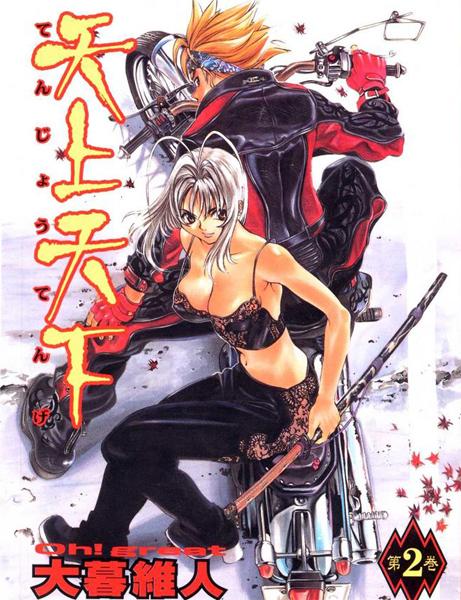
 Tenjo Tenge by artist and writer, oh!Great
Series: Tenjo Tenge
Genre(s): Action/Adventure/Martial Arts/Romance
Publisher: Viz Media
Available Formats: Paperback and DVD
Description: Knuckle-busting brawls, badass babes, and the toughest student body ever to mix it up under one roof. Welcome to Todo High, where the only rule is: get strong or get schooled. Soichiro Nagi and Bob Makihara have always been the meanest street brawlers around. When they enter Todo High they plan on carving out a reputation as the strongest fighters in their new school—easier said than done in a place that’s dedicated to training its students in the art of combat!
This review is based on earlier copies from Japan before the manga and anime became licensed in the US.
StrangenessAbounds’s Review:
To Avoid Confusion: now defunct-company called CMX initially licensed Tenjo Tenge and heavily censored a great deal of the sexuality. When CMX died, Viz Media picked up the license and is releasing it in it’s original, uncensored form starting June 21st. In short, there are two versions of Tenjo Tenge floating around, even if the CMX licensing was incomplete at the time of the company’s closing.
Tenjo Tenge (天上天下) is…how can I define it? Tenjo Tenge stands out in that it is epically enormous, especially the manga. It follows the lives and thoughts of several different people across several different eras. I could say to think of this as a massive soap opera (Days of Our Lives-type massive) with freaktons of gory punch-outs. But I think that would undermine the spiritual and historical sides of this manga/anime. “Tenjo tenge” translates literally to “the heaven and the earth,” and the manga (the anime only has 26 episodes and in my opinion, doesn’t get that much done inside roughly 780 minutes) incorporates powerfully a wide variety of at least two Eastern belief systems. Additionally, almost a quarter of the manga is devoted to the depiction of an old war in the Japanese feudal era.
But when I went looking for an adequate summary to put in this review, several websites offered several different summaries. The manga – which began in 1998 and did not finish until 2010 – has twenty-two released volumes in Japan. That’s the kind of enormous I’m talking about.
Character Development: Oh, good lord. There are many, many players in this show whose backgrounds are fully fleshed out and who actively play large roles in the progression of the plot. On the one hand, the manga nor the anime can be accused of two-dimensional characters. On the other hand, it’s very easy to get people mixed up and lose track of the less major but still “destined” characters, especially if the current plot thread is being suspended for the sake of completely fleshing out that particular character right then. There’s no way that this manga could have been this long and not have had a bigger cast of main characters than The Lord of the Rings.
However, I became deeply attached to these characters’ stories and to them. It was difficult to do anything else but keep flipping pages or keep watching episodes. When a character cried or hurt, I felt it from the bottom of my heart.
Artwork and Animation: I’m going to get this out of the way first: this is clearly an anime/manga that was created with the male demographic in mind. The cover of the first volume released in Japan prominently features a massive upskirt shot of one of the leading ladies. If that appears on the cover, you know that everything else after that has a lot more. The boob shots, butt shots, upskirt shots and completely undressed women happen with enough frequency that it becomes boring and repetitive. This is, basically, the height of fanservice. A great deal of the nudity, however, is played for comedic effect, almost as though it’s mocking the ecchi genre.
The animation in the anime is typical of most animes. The OVAs (think of them as pilot TV episodes) tend to be smoother than the other episodes, but as a whole, the anime is fun to watch and certainly colorful. Neither does it hold back on fully depicting the gore that comes as a result of the constant fighting and I do mean, the constant fighting. I know that this is a martial arts themed anime and manga, but whenever a character needed to settle matters, more often than not, they go to fists or swords or chairs or whatever weapon was handy at the moment. Often it’s fists. Also, the characters who get into the fight are often so roughed up that I’m led to believe that they’re dead, but no, they’re carted off to the hospital and in a matter of weeks, they’re back to fighting again.
The fight scenes, as they happen, are painful and fun to watch and read at the same time. There’s a certain amount of glee I feel as a pair of main characters fight one another to the (almost) death. The style in which the fight scenes are drawn tend to be reminiscent of Dragon Ball Z fight scenes, with just as much yelling and unnecessary noise.
But the hair. The hair in both the anime and manga is wild. Final Fantasy characters would be ashamed that their own were lacking in comparison.
Plot: The anime was fairly short in comparison to what the manga covered. Apparently, the project was abandoned after only twenty-six episodes, so it doesn’t look like we have the first full arc of the complete story of Tenjo Tenge. But for the most part, the plot moved along fairly quickly until it came to flashbacks, which lasted for episodes and episodes and episodes. The uber-long flashbacks felt too long and tedious to me, and I suspect they were slow because of the constant, long inner monologuing that most of the characters had. I understand that the inner monologuing was for the purpose of expanding the character’s rapport with the audience, but there was enough that it effectively stalled the progression of the plot.
As for the manga…wow. It’s as though the plot has severe ADHD and concentrated on one sub-plot first, then moved onto the next without completing the previous sub-plot, then moved on into another long, protracted flashback. Again, it’s difficult to keep up with.
BUT, I never wanted to stop reading. In spite the plot’s issues, it was a thoroughly addictive read. And I never wanted to stop watching. I read and watched for entire days when I should have been otherwise productive, heh.
Music: The music in Tenjo Tenge is likely stock music and, in the midst of watching, I didn’t pay much attention to it.
Final Thoughts: This is a bit of a mixed bag. The anime Tenjo Tenge is vicious, mostly fast-paced, phenomenally sexist and addictive. I wish that it had been completely made, but given the incredible length of the manga and the tough economic times that anime and manga publishing companies are presently facing, it would have been difficult to finish, to say the least.
If you want to get into the Tenjo Tenge adventure, try reading the manga. It is a little easier to get into and it will take you for a ride that you won’t easily forget. It’s been a two or three years since I read the manga all the way through (they were still releasing the chapters in Japan when I started), but it’s a manga that is epic in scope and sheer volume, so it was easy for me to remember most of what happened.
Tenjo Tenge is certainly a classic in martial arts anime and manga. If you’re into the martial arts genre and would like to read Tenjo Tenge for yourself, the first volume will be released by Viz Media on June 21st.
 for the manga
 for the anime
Buy It Now:
 |


Reviews Elsewhere:
“Tenjou Tenge: Series Review” by Glo The Legend
“Tenjho Tenge, School Rumble and Fan Service” by Angela Moseley
“Tenjho Tenge: Volumes 1-6” by TheAnimeBlog.com Bear in mind that this review concerns the old CMX releases
“Tenjou Tenge Manga Review” by God Damn I Was Bored


Follow Us!