Giveaways! None at the moment!
Check back soon!
TDF Staff Editor/Head Writer:
TDF Pamela
Regular Contributors:
Amanda
The Bibliomaniac
Emily
Lady T
LamoreVincera
Stacy B
Strangeness Abounds
WereGeek
To read more about us, head over and meet the geeks!
|
Strangeness Abounds, on January 13th, 2011 |
 Review of the Finder series by Ayano Yamane
Buy it Now: on Amazon
Description: While on assignment trying to document the illegal activities of the Japanese underworld, photographer Takaba crosses paths with the dark and mysterious leader Asami. Asami takes Takaba captive, in an attempt to subjugate and possess him. But when the son of the Chinese mafia enters demanding evidence that Takaba may have, will Takaba be able to survive being caught in the crosshairs of a deadly underworld feud?
This review is based upon copies the author bought.
Before you read ahead, visit my previous post, StrangenessAbound’s 見 & 漫 Page: On Sexual Content in Anime and Manga.
StrangenessAbound’s Review: Ayano Yamane’s Finder series (ファインダーの標的, Faindaa no Hyouteki) is perhaps one of the hottest yaoi series on the market in Japan and in the United States today, and for good reason. The art is well drawn, the story is addictive, the characters are three-dimensional and dynamic and the sex is explicit and uncensored in both Japanese and English releases. Finder had licensing issues outside Japan for several a few years before Digital Manga Publishing’s imprint, June, picked it up and began publishing it in the United States in September of 2010.
The art in Finder is, to put it plainly, exceptional. Every single emotion on every character’s face – pain, love, pleasure, fear, anger – is depicted with such subtle strokes of Yamane’s brush that it’s easy to glance over at first, especially when one is reading “for the good parts” (i.e. the sex). The men’s – specifically the seme’s faces – are so sexily drawn that it takes my breath away. I think it’s their eyes and their smug smiles as Asami, a powerful and well-connected black market drug lord, and the son of the Chinese mafia, Fei-Long, capture Takaba Akihito over and over and over.
Part of what sells the Finder series to me so strongly is the fact that Yamane takes the time to flesh out each main character and several of the supporting cast members. You understand why they are doing what they are doing – they’re not necessarily doing it just because they can. Of course, the exception comes when Asami captures Takaba just to have sex with him. ;) By the time I was finished with the the first and second volumes of the series, Target in the Viewfinder and Cage in the Viewfinder respectively, I already cared about what would happen to Takaba, Asami and Fei-Long. I wanted to read more about their stories and how their conflicts would end.
Of course, the primary sell for the Finder series is the frequent, explicit, kinky and uncensored sex that goes on between Takaba Akihito, Asami and Fei-Long. Just a few pages into first volume, we see Akihito naked and trussed up in black leather for Asami’s viewing and screwing pleasure. Akihito also spends a great deal of his time being caught in Asami’s trap (First Volume: Asami – “I just want to come into your house to get out of the rain. Wait, no – psych! I want to screw your brains out.” :D ), Asami allowing Akihito to wriggle his way out of his trap, and then, Asami catching Akihito again to start the cycle over. It’s not even remotely boring. I found myself cheering Asami on, consuming pages as quickly as possible to get into Asami’s and Akihito’s next encounter. Think the Marquis de Sade’s Justine as far as Takaba Akihito’s situation/relationship between Asami and Fei-Long. I (and apparently many other readers) find this crazy hot – I understand that other readers of yaoi will not find the rape-y aspect of the Finder series so appealing.
With that being said, if you’re a yaoi fan and you don’t mind and even enjoy explicit manga, you have no excuse not to at least investigate the Finder series for your own personal library.

 Strangeness Abounds
StrangenessAbounds may be more of a truthful moniker than the author will admit to -- when she is not obsessively finding "just the right word," exploring the taste of various chai lattes or arguing over what is canon in "The Legend of Zelda," she is planning her next sushi outing. "StrangenessAbounds" is a writer of both fiction and non-fiction as well as being an editor and English teacher. She graduated in 2009 with her BA in English and is working towards her MS in English. She can be contacted through e-mail.
profile
Strangeness Abounds, on December 30th, 2010 |
I’m making this a “follow-the-link” because I want to be as sensitive as possible in regards to the subject matter.
Show »
I’m writing on this topic matter because soon, I’ll be reviewing several big name anime and manga that may feature dubious sexual consent, no consent, “shotacon,” or other, seemingly strange, sexual activities trademark to several anime and manga genres. *deep breath*
When I review these anime and manga, I want you to know that I, in no way shape or form, appreciate these kinds of sex in real life. Additionally, because my reviews appear on TDF, this does not mean that TDF, nor any of my fellow discriminating fangirls, appreciate these kinds of sex in real life.
A while back, I reviewed an anime/manga combination called Dance in the Vampire Bund. In DitVB, the “Queen of the Vampires,” Mina, appears to be a nine year-old girl and is frequently seen in scant clothing, if anything at all. In the review, I stated that in Japanese culture, nakedness is not always seen as sexual. While Mina is naked or nearly naked in DitVB, her state is used to convey both her power and innocence. When her nakedness is used against her, Mina’s pride is clearly wounded. Additionally, both the Sailor Moon anime and manga feature Sailor Moon/Usagi and her Sailor Senshi as naked on occasion. In all instances, their nudity is used to illustrate their time-honored beauty. If I review an anime/manga that features nudity, try to understand the context in which the person is.
Now onto the stickier stuff: dubious sexual consent (shortened to dub-con) and no consent (shortened to non-con). In my next review, I’ll be reviewing Love Prize in the View Finder, a manga by Ayano Yamane that features a twenty-three year-old man being forced into sex with two powerful mafia bosses, who are also men. LPinVF is an extremely popular manga series, but it is not for the faint of heart because it features both dub-con and non-con. In this matter, all I can say is, “It’s paper, ink, and voice actors if it’s an anime, NOT real people.” Dub-con and non-con in anime/manga may appeal to some people, it may not to others.
In any sex scene found in a Japanese anime/manga, you will find that the receiving character (RC) frequently says, “No,” during sex, and says it repeatedly. Of the sexually explicit manga I’ve read (and I tend to stick to the warm, fuzzy, romantic type), “No,” does not equal, “Stop, I don’t want to do this.” I’ve only been reading manga and watching anime for a few years, but this is my observation: when the RC says, “No,” it seems to be a way to preserve the RC’s purity to the audience. In American entertainment culture, the RC often says, “Yes,” during sex, but at least in Japanese anime and manga I’ve read, “Yes” during sex translates to the RC being a slutty character. “No,” even when the RC is clearly enjoying himself/herself with their partner, often keeps the RC from the “slut” category. Strange and opposite to our American customs when featuring sex in movies, books and the like, but there you have it.
Onto the stickiest stuff of all: the shotacon strain of anime/manga. Shotacon features a boy under the age of consent and most of the time, an older man, in sexual situations. Some shotacon features a boy and an older woman, but I will not be reviewing (or reading/watching that for myself) at any point. In the future, I will be reviewing a manga series called Koi Musubi, Yume Musubi in which a seventeen year-old boy works to become the boyfriend of and seduce his idol, who is a Shinto priest and also thirty years old. If you choose to read this series for yourself, understand that age difference isn’t as big a deal in Japanese sociological culture as it is for American sociological culture. But back to KMYM: the fact that the younger boy wants his idol to become his boyfriend may not sit well with some people, and I get that. I personally enjoy the series, but I also understand that KMYM is quite the exception to the shotacon genre in that it is warm, fuzzy and thoroughly romantic. It may (or may not) help to know that the vast majority of artists and writers for the shotacon strain are women.
As for other types of sex and sex activites, I will not be reviewing them on TDF unless specifically requested. There are lots of types of sex in Japanese manga and anime, but I refuse to review (or read/watch, for that matter) most of those kinds of things. They simply do not appeal to me, but I will not certainly not condemn someone who finds the appeal in other types of categories/strains.
I covered these topics because they are involved with the anime/manga I plan on reviewing and I felt that a simple disclaimer would have been too little. I needed to put some context on my reviews before I put them out there.
And one more time, just to cover my butt, the butt of TDF and the butts of my companion discriminating fangirls: we do not condone nor promote nor condemn the sexual acts that may be in the anime/manga I will be reviewing in “real life.” Anime and manga are simply paper and ink and, in my opinion, should not be examined the same way we examine “real life.”
Strangeness Abounds
StrangenessAbounds may be more of a truthful moniker than the author will admit to -- when she is not obsessively finding "just the right word," exploring the taste of various chai lattes or arguing over what is canon in "The Legend of Zelda," she is planning her next sushi outing. "StrangenessAbounds" is a writer of both fiction and non-fiction as well as being an editor and English teacher. She graduated in 2009 with her BA in English and is working towards her MS in English. She can be contacted through e-mail.
profile
Strangeness Abounds, on December 9th, 2010 |
 Misaki and Usami Junjou Romantica: Pure Hearted Romance (純情ロマンチカ Junjō Romanchika) is an anime and manga series by Shungiku Nakamura, but this isn’t your average collection of heartwarming, romantic stories. Well, maybe it is, but it is rather unconventional when compared to American movies and books portraying the love of several couples. Junjou Romantica focuses itself entirely on the love to be found between two men. I will be focusing on the anime because I haven’t had time to sit down and read the looong manga series. ^.^
Plotline description from Amazon.com:
Romantica: Misaki is struggling to prepare for his college entrance exams, so his brother arranges for a private tutor. But Misaki’s nightmare is just beginning when his tutor, Usami, comes on to him! How will Misaki ever manage to pass his exam? And why does he feel so mysteriously drawn to Usami? Egoist: Just when Kamijou’s life is at its lowest, he has a chance meeting with a man who never lets anything hold him back: Nowaki. His name means typhoon, and he s about to take Kamijou on a whirlwind ride that will turn everything upside-down. Terrorist: Miyagi always seems to shrug off the cares of the world with a joke and a smile. But even he has problems, although he doesn’t let them show. Foremost is Shinobu, a relentless young man who is adamant that they’re destined to be together.
Junjou Romantica is a romantic comedy TV series, and while there are three story arcs, my personal favorite is Misaki’s and Usami’s storyline (the first in the above description). Misaki’s relationship with his tutor is complex, hilarious and sweet. Usami tries to get Misaki to admit that he is in love with him for much of Season 2 of Junjou Romantica and Misaki pulls the classic romantic stunt of “running away” from admitting the truth.
This genre of love between two men is called “yaoi.” It is an acronym for something in Japanese that translates basically to “porn without plot.” At no point in the anime is Junjou Romantica explicit with its sexiness (the manga is fairly explicit), but it’s perfectly clear that two men are having sex. A more accurate genre to put the anime Junjou Romantica would probably be “shonen-ai,” which translates literally to “boy love.”
While Junjou Romantica is mostly funny and sweet, there has been some attention drawn to the fact that Misaki is a college-aged boy living with and sleeping with a man in his late 20’s, early 30’s. It is not a problem for many people in the anime & manga community, however, the age difference has ruffled the feathers of people outside the community. I enjoyed Junjou Romantica. I struggle with people outside the anime & manga community pushing their moral theories on people inside the community, so I will make this statement: this is animation, not real life. Because animation is, by nature, fantastic, it should not be measured with the same kinds of standards as are given non-animation features.
There – I said it. ^.~
I would highly recommend the anime Junjou Romantica to anyone interested in gay romantic comedies. At this rate, you’re not likely to see anything like this created in America anytime soon, simply because Japanese views on sexuality and American views on sexuality are in two very different places. In this perspective, the anime Junjou Romantica is a fun mental getaway that also has the potential to break apart American social taboos. Both the anime and manga have already been subtitled/translated and imported into the US, so maybe we’re onto something good as far as social change.

Strangeness Abounds
StrangenessAbounds may be more of a truthful moniker than the author will admit to -- when she is not obsessively finding "just the right word," exploring the taste of various chai lattes or arguing over what is canon in "The Legend of Zelda," she is planning her next sushi outing. "StrangenessAbounds" is a writer of both fiction and non-fiction as well as being an editor and English teacher. She graduated in 2009 with her BA in English and is working towards her MS in English. She can be contacted through e-mail.
profile
Strangeness Abounds, on November 30th, 2010 |
 An American poster for Princess Mononoke Princess Mononoke (もののけ姫 Mononoke-hime), written and directed by Hayao Miyazaki, was released in 1997 and is the third highest-grossing movie in Japan. The second highest-grossing movie in Japan is Howl’s Moving Castle and first highest-grossing is Spirited Away – all, of course, by Hayao Miyazaki. Princess Mononoke won multiple awards across the world for its musical score, its thought-provoking plot and most of all, its hand-drawn animation combined with CGI.
(Lifted from Amazon.com because I’m writing this Thanksgiving morning and I’ve already had too much to eat. ^.^):
Set in medieval Japan, Miyazaki’s original story envisions a struggle between nature and man. The march of technology, embodied in the dark iron forges of the ambitious Tatara clan, threatens the natural forces explicit in the benevolent Great God of the Forest and the wide-eyed, spectral spirits he protects. When Ashitaka, a young warrior from a remote, and endangered, village clan, kills a ravenous, boar-like monster, he discovers the beast is in fact an infectious “demon god,” transformed by human anger. Ashitaka’s quest to solve the beast’s fatal curse brings him into the midst of human political intrigues as well as the more crucial battle between man and nature.
I like the fact that Princess Mononoke doesn’t smash its audience over the head with, “We need to save the environment” and “Humans are evil because they destroy nature for their selfish purposes.” Of course, I believe in and do my part in preserving the environment to the best of my ability. But Princess Mononoke does what American “save the environment” films can’t do – be subtle about the message. Princess Mononoke forces the thinking viewer to consider both viewpoints of the humans and of nature, without forcing an overly didactic message down the throat of the viewer.
I also absolutely love the animation in this film. The blending of hand animation with computer generated animation is smooth enough that I have to watch carefully for those moments. Of course, according to Miyazaki tradition, Princess Mononoke is vividly and uniquely animated – specifically, the gods. The Great God of the Forest appears almost like a deer with many horns, but a closer view of the Great God chances that first impression almost entirely.
However, this film almost deviates from the tradition of watching a young woman work through her “rites of passage,” so to speak, for the central protagonist is Ashitaka. Enter San. San is a woman who was raised by the wolf gods of the Forest and who considers herself to be one of the wolf clan. She frequently fights against the human beings that provoke evil from the Forest and single-handedly sabotages the Tatara clan’s city. She and Ashitaka cross paths and something that could be considered to be romantic love spawns. I’m putting in the qualifying statement because I’ve watched the film with friends who do not think that Ashiktaka and San thought of each other romantically.
Anyway, the viewer is privy to San’s gradual growing up and away from the clan of wolf gods and begins to see through the eyes of humans as well as the gods with whom she was raised – however, her story is not as central as Ashitaka’s is. Ashitaka’s fight to rid himself of the curse on his arm and spreading further onto his body, as well as his adaption to his new environment and the social and political implications found within that environment takes up much of the humans’ screentime.
Princess Mononoke isn’t my favorite Miyazaki film, but it is still one of my favorites. I tend to balk a little at the American voice-acting simply because whoever cast the voice actors just picked celebrities. But I was surprised that the voice actors did (mostly) a good job. I still prefer to watch Princess Mononoke with Japanese audio and English subtitles. I absolutely love the tension between man and nature – Miyazaki definitely knows how to weave a story. Of course, I highly recommend Princess Mononoke to anyone looking for a film to make you think.
 San and Ashitaka
Strangeness Abounds
StrangenessAbounds may be more of a truthful moniker than the author will admit to -- when she is not obsessively finding "just the right word," exploring the taste of various chai lattes or arguing over what is canon in "The Legend of Zelda," she is planning her next sushi outing. "StrangenessAbounds" is a writer of both fiction and non-fiction as well as being an editor and English teacher. She graduated in 2009 with her BA in English and is working towards her MS in English. She can be contacted through e-mail.
profile
Strangeness Abounds, on November 11th, 2010 |
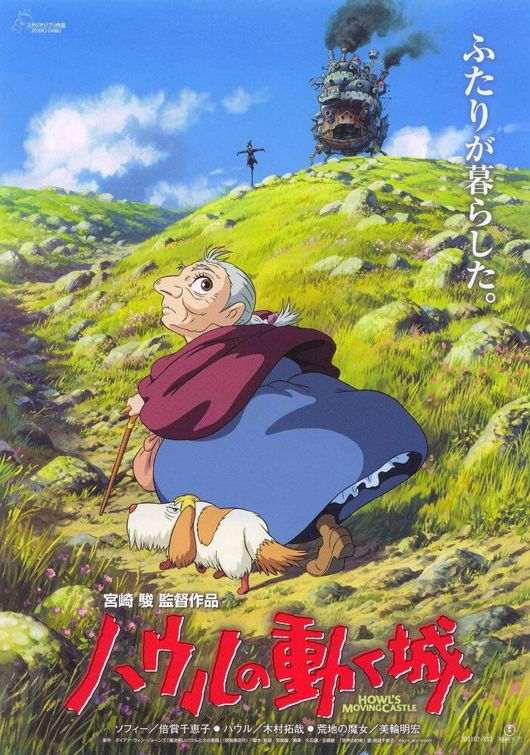 The Japanese poster for Howl's Moving Castle Howl’s Moving Castle (ハウルの動く城) is a 2004 anime film adapted from the book by the same name by Diana Wynne Jones. The film Howl’s Moving Castle directed and animated by Hayao Miayazaki was nominated for Best Animated Feature in the 78th Academy Awards for its beautiful music, vivid and smooth animation, a well-voiced American dub, a compelling, addictive story and strong character development.
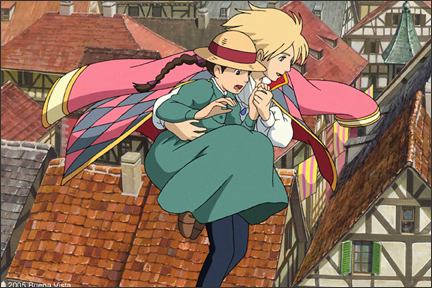
Sophie is a plain hat maker who rather enjoys her wallflower side. Before her transformation, Sophie meets with a sorcerer whose name she later discovers to be Howl. One evening, after her hat shop is closed, she is attacked and turned into an old woman by the Witch of the Waste, an evil woman who uses her power to hurt those who have crossed her in the past. Sophie decides to leave her hat shop behind and goes into the mountains to try to find a cure to her curse. In the process, she runs into Howl’s castle. Inside the castle, Sophie meets Calcifer, a fire that talks and Markl, Howl’s assistant. Sophie goes on a journey of self-discovery, maturation and learning to love those who might be considered as unlovable.
This was the third Miyazaki film that I watched and this may be my favorite of all, Princess Mononoke coming in at a close second. The setting in which Howl’s Moving Castle takes place instantly captured my imagination – an idyllic, Victorian-era, steampunk world. The slowly developed love story between Sophie and Howl also made me melt a little inside. ^.^
As per Miyazaki tradition, Sophie learns to grow out of her wallflower persona and into a woman who can make firm decisions. But unlike Miyazaki tradition, much of Sophie’s screen time is consumed with being cursed as an old woman. So I find it interesting to see Sophie’s attitude about herself and her worldview change as a result of her suddenly becoming eighty years old. I also like how Miyazaki balanced Sophie’s growth with her falling in love with Howl. Sophie didn’t need Howl’s love to mature – in fact, I doubt that Sophie needed Howl around in order to grow. Sophie’s new persona as an old woman began refining her character for her, without Howl’s presence. And yet, because Sophie grew so much through choosing how to react to her circumstances, her love for Howl is that much sweeter.
Of course, I would highly recommend, even demand, that you go out and Netflix queue or buy Howl’s Moving Castle immediately. I think you will appreciate the sophistication of the animation and the deeply moving plotline. I also hope that you will enjoy Sophie’s character-building journey through love and war.
Strangeness Abounds
StrangenessAbounds may be more of a truthful moniker than the author will admit to -- when she is not obsessively finding "just the right word," exploring the taste of various chai lattes or arguing over what is canon in "The Legend of Zelda," she is planning her next sushi outing. "StrangenessAbounds" is a writer of both fiction and non-fiction as well as being an editor and English teacher. She graduated in 2009 with her BA in English and is working towards her MS in English. She can be contacted through e-mail.
profile
|
Subscribe 
Subscribe by Email

 

Become a Friend of TDF!
Copyright Information 
All original content copyright to The Discriminating Fangirl and its respective authors, 2007-2010.
Please do not reproduce posts in their entirety without written permission. You may quote sections of posts with attribution (i.e. attribute the quote to The Discriminating Fangirl & the quote's author, including a link to the original post).
|